
This is one of my favorite questions that I always ask my students. Their answers are telling, innocent, and imaginative. The responses I receive include “one billion, trillion dollars,” “bring my dog back from the dead,” “a Barbie dream house,” and “my family living in our own house.”
It is also a question I have mulled over for years. The first wish I would make has been solidified for some time. I wish to be able to communicate in every language in every form whether it is writing, reading, speaking, etc. I have encountered moments where if I knew Spanish or ASL, I could have helped someone with a question or helped them feel connected. I am not the stereotypical American who believes that you need to speak English if you are in America.
I find that statement absurd.
I believe those who are bilingual or are polyglots are truly remarkable and far more connected and immersed in our global society. There is research coming out about how those who speak multiple languages have far more complex brain structures and benefits overall. I highly recommend the book The Power of Language: How the Codes We Use to Think, Speak, and Live Transform Our Minds written by Viorica Marian.
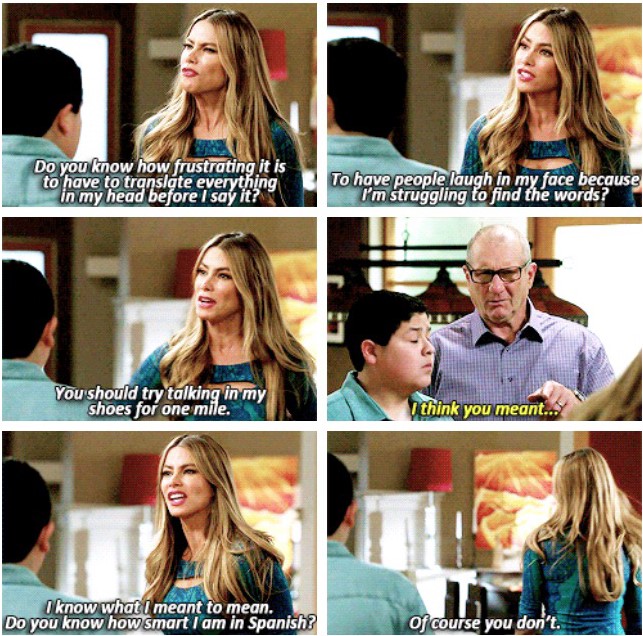
The image above is from Modern Family where Sofia Vergara’s character states:
Gloria: “Do you know how frustrating it is to have to translate everything in my head before I say it? To have people laugh in my face because I’m struggling to find the words? You should try talking in my shoes for one mile.”
Husband: “I think you meant…”
Gloria: “I know what I meant to mean. Do you know how smart I am in Spanish? Of course you don’t.”
Learning another language is challenging. Being thrown into a culture whose language is not your own drastically changes everything. From my own personal experience, I know how it feels to be expressively isolated. I am highly educated, articulate, and have an expansive vocabulary. In English. When I was living in Thailand, I knew my numbers, how to say “hi,” “how are you?,” “thank you,” and “no worries.” I knew the words for “little,” “pain,” and “pretty.” I had a random assortment of fruit names, how to order rice with egg and how to ask “how much.” That was it. I had zero ability beyond that to explain how I felt, my thoughts and opinions, or have any sort of discussion or conversation. I felt a deep loss because I could not express who I was.
I work with many families who speak other languages. I will go out of my way to ensure they have a translator even if their English is considered “good.” This year I encountered a mother who did her best to explain the needs of her child. She is a native Mandarin Chinese speaker and she had recently moved to the states with her children. Although her English was wonderful, I knew if I wanted all the information she wanted to give me about her child in the way she needed to provide it, she needed the ability to speak it in her own language so neither of us missed anything important. Having the translator was vital. She felt heard and I felt confident I had the information I needed to help her son.
I distinctly remember growing up how those who did not speak English were seen as less then. They were “stupid.” That is how my section of America saw non native speakers. For an example in the reverse, I recently watched a Korean show called Hotel King. One of the situations within the series was the rift between the hotel staff (based in Korea by the way) that did not speak fluent English versus the hotel staff that had been trained overseas and spoke fluent English and Korean. The latter was seen as better than the native speakers despite their immense skills and being based in Korea.
Language can be the great divider or the great equalizer.
Considering I probably won’t find a genie’s lamp anytime soon…I made the move to start learning languages. Although I took four years of Spanish in high school, it was not conversational and it was taught by a fluent European Spanish speaker. This means some of the words or grammar rules are different than the Hispanic Spanish I am attempting to learn. In my area, dual language learners are predominately native Hispanic/Mexican/Latino. I am lucky to have a few staff who are willing to help me speak and write in Spanish. Because of this, I am predominately learning through Duolingo, Google translate, and trial and error. The staff I’m working with are those that I have known for a few years. I will say that our relationship changed the moment I told them I was attempting to learn. The excitement and joy was clear. That someone wanted to learn their language was rare.
Making an effort to meet someone where they can be their authentic selves can be life changing.
Due to being a glutton for punishment…I am also learning Korean. Since I watch a great deal of Korean TV and K-Pop, I have come to love listening to the language. Although there are subtitles, I want to understand what I am hearing exactly as it is being said. I attempted to learn it via Duolingo but was struggling greatly hearing the differences between sounds. South Korea has institutes all over the world to promote Korean language and culture. I found a local center who offers Korean classes online, Korean Center, Inc. I am now in week four of learning Hangeul. I am learning to read, write, and speak at the same time.
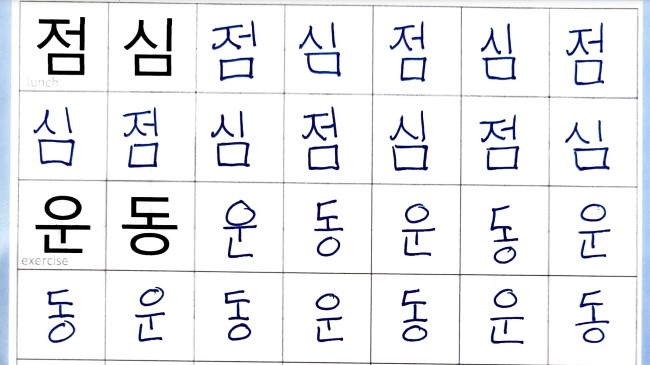
This is an example of my writing practice. I am 40. Have three degrees, a handful of certificates, and a wealth of experiences.
I am now in Korean kindergarten.
Having a native speaker teach is making all the difference. Specifically, she is teaching us where to put our tongues, how the sounds come out of our mouth or nose, and the position of our lips. There are many sounds we do not have in English. There are some sounds such as the batchim, or final consonants, that we learned last night “ㅁ, ㄴ, ㄹ, ㅇ, ㅂ, ㄷ, ㅅ, ㅈ, ㄱ, ㅎ” that I cannot hear a difference but only know there is a difference due to the position of my tongue. My brain is trained in English, so it is attempting to decipher what it is hearing into something it knows. So, although the sounds the teacher is making is the same sound “부부”, my English brain is hearing something different. And though I could write out Hanguel in romanization which puts the letters/sounds we are familiar with down instead of Hangeul, I would be learning the sounds incorrectly.
Needless to say…my brain hurts. It is frustrating. My mouth and tongue are tongue-tied from moving them in ways that are unfamiliar. And my hand writing sucks…
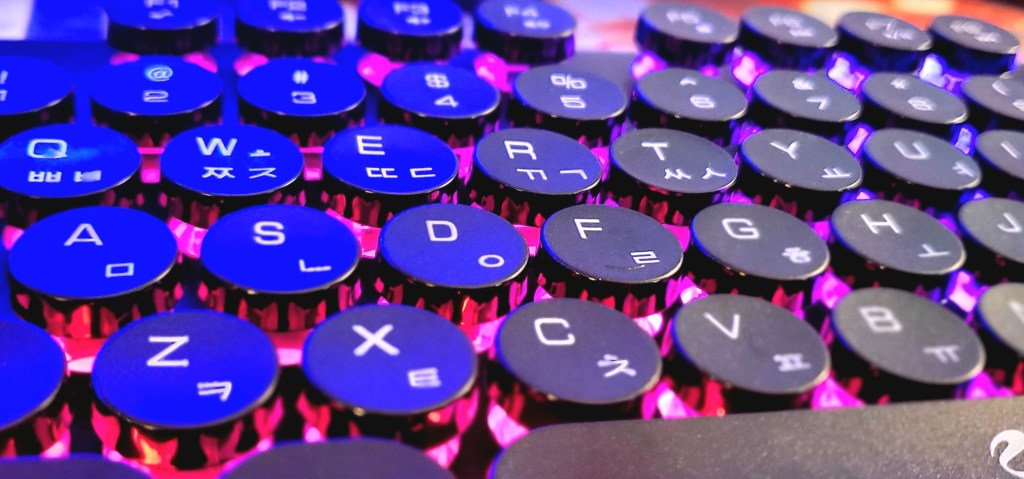
I cannot wait until week 5!

 Into The Ether